
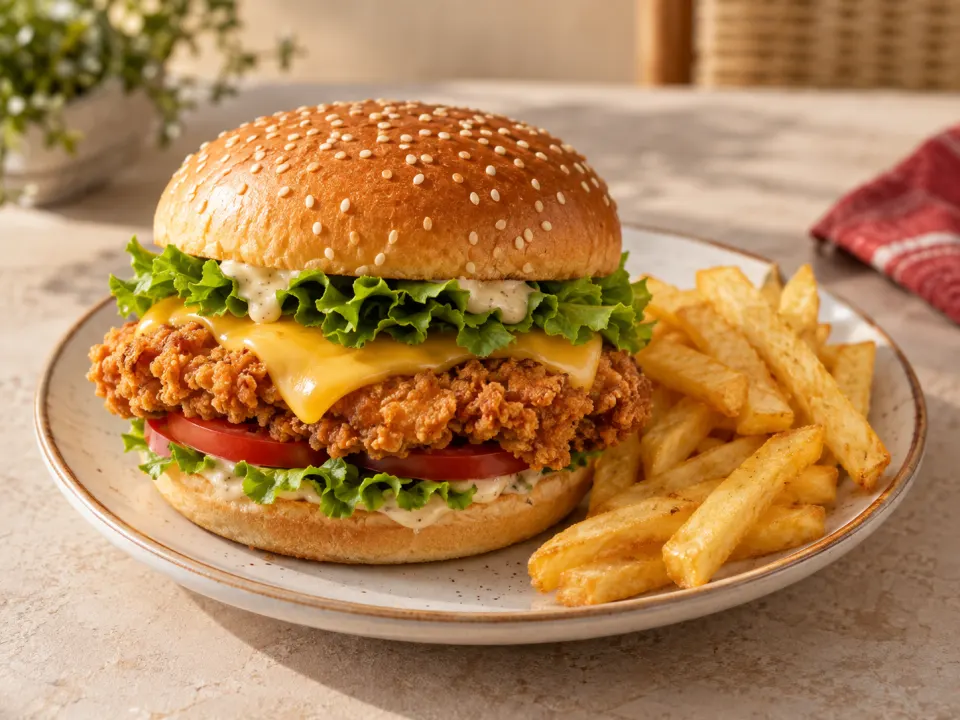
Burger
A burger concentrates filling in a soft bun and is usually the clearest choice when the patty or fillet is the main attraction. Sauces and fried additions can make it messy during transport.
Club sandwich
A club uses stacked sliced bread and often spreads fillings across several layers. It can feel larger and is commonly cut into sections, making it useful for sharing but less secure while walking.
Wrap
A wrap distributes filling along a rolled bread and usually travels well. It is not automatically lighter: cheese, fried chicken and rich sauces can make it as substantial as a burger.
Our judgement
Pick a burger for focus, a club for variety and possible sharing, or a wrap for portability. Confirm the actual filling rather than relying on the format name.
Practical field note
Think about how long the item will sit before eating. A burger protects its centre but can slide when heavily sauced; club triangles are easy to share at a table; a wrap usually travels with fewer loose layers. For example, choose a wrap for a short walking lunch and a club when two people want to sample one substantial sandwich. None of these formats proves a smaller portion or a particular nutrition profile, so compare the stated filling and additions.
Bread-to-filling ratio and eating context
A burger bun concentrates the filling and keeps a clear top-to-bottom structure. A club sandwich spreads ingredients across multiple toast layers, often increasing bread and making cross-sections easy to share. A wrap distributes the filling along its length and can offer more consistent bites, provided it is not overfilled. Those differences matter even when the protein and sauce are similar.
At a desk or in a vehicle, loose club sections and heavy sauce can be inconvenient. At a table, a club can be divided and sampled. A burger makes the main patty or fillet prominent, while a wrap suits a balanced mixture of filling and vegetables. Choose around the eating environment, then compare ingredients.
Do not infer “lighter” from the format
A wrap can contain fried chicken, cheese, mayonnaise and chips; a burger can use a grilled filling and restrained sauce. The outer shape does not establish calories, allergens or portion. Likewise, a club can range from a simple chicken-and-vegetable stack to a large layered meal with fries.
Ask what protein preparation, cheese, sauce and sides are included. If you want a simpler build, request fewer additions only after confirming that the filling is not pre-mixed. When ordering for a dietary need, verify bread and sauce as separate ingredients and ask about shared equipment. This website describes selection logic but cannot certify a current branch recipe.
Decision checkpoint
Modification requests work best when they are short and verifiable. “Sauce on the side” or “no cheese” is easier to execute than rebuilding an item with many substitutions. Even then, confirm whether the filling is pre-mixed and whether removing one component addresses the actual concern. Excessive modifications can also make packaging less stable or erase the feature that defines the format. If the standard build is far from what you want, selecting another format may produce a better result. For a shared tasting, cut items only after checking that diners have compatible dietary needs. These recommendations improve clarity but do not guarantee that a branch can accommodate every request or prevent cross-contact.
Quick decision summary
Use the format as a handling clue, not a health claim. Burgers focus the centre filling, club sandwiches layer and divide, and wraps distribute filling for portability. Compare the actual protein, bread, cheese, sauces and sides. Match the choice to where it will be eaten and how long it will travel. Keep modifications short and confirm whether ingredients are pre-mixed. For allergies, include bread, sauce and shared equipment in the question. The best choice is the format whose standard build already fits the situation, because extensive substitutions can be misunderstood and may undermine texture.
When this guide should be reviewed
Recheck this comparison whenever a branch changes its bread, standard side or signature sauce. Those details can reverse which format travels best or feels most substantial. A new photograph alone is not enough; the underlying item description must also be confirmed.
Sources and verification
Sources checked on 2026-09-20. Scheduled review by 2027-03-20, or sooner if a material fact changes.